Area Worksheets
Practice area calculations across supported rectangular and square shapes using reproducible numbers and diagrams. Compare the area formulas with separate printable solutions.
Area Worksheets
Practice worksheet · Sheet ID 20261104
Quick answer check · Your answers stay in this browser. Enter the answer format shown beside each question, then check without revealing the answer key.
Enter your answers to begin.
Area Worksheets: general practice and focused alternatives
This collection offers its supported question types, but does not automatically cover every related math skill or grade-level search. If you need a specific task, use a dedicated practice generator instead.
- Area Of Triangles Worksheets — Rectangular and square area vs triangle base-and-height problems
- Area Of Parallelograms Worksheets — Rectangular and square area vs parallelogram perpendicular-height practice
- Area Of Trapezoids Worksheets — Rectangular and square area vs trapezoids with two parallel bases
- Surface Area Worksheets — Flat rectangle/square area vs three-dimensional cube or rectangular-prism exterior area
How to use this worksheet
- Read the dimensions shown in the question.
- Choose the appropriate area, volume or surface-area formula.
- Record square or cubic units where appropriate.
Refresh the seed to generate another distinct set. For review, download the separate answer PDF instead of printing answers over the questions. Worked steps are available only on step-verified topics.
Example printable practice
A fixed-seed preview created from the same deterministic generator used above.
Circle area worksheets: radius, diameter and sector area
Area of a complete circle is A = πr²; radius is half the diameter. For a sector with central angle θ in degrees, use A = (θ / 360) × πr². This page now offers an opt-in sector and circle-area generator in addition to the existing rectangle/square worksheets.
- Choose a full circle with a given radius or diameter; compute the positive radius before squaring it.
- Choose a semicircle (180°), a quarter-circle (90°), or a minor sector with angles from 30° through 180°. The diagrams draw the stated angle from the circle center.
- Choose Find radius from area to reverse A = πr² using the positive square root. Print matching student questions, teacher key and worked solutions in US Letter or A4.
Example: a quarter-circle of radius 6 cm has area 9π cm². An angle of 60° and radius 3 cm gives (3/2)π cm². Answers use exact reduced rational multiples of π; no 3.14 approximation is assumed. This does not claim circumference, arc length, composite shaded areas or sphere volume. The original seeded worksheet and share link are unaffected.
Composite figures area worksheets — subtract a cutout or add two rectangles
A genuine L-shaped region is formed by removing a smaller rectangle from the upper-right corner of a larger rectangle. The formula is A = W × H − w × h, where W and H are the outer dimensions and w and h are the cutout's width and height. You may also split the L into nonoverlapping rectangles and add their areas.
- For an outer rectangle 10 cm wide and 8 cm high, with a 3 cm × 2 cm top-right cutout, the result is 10 × 8 − 3 × 2 = 74 cm².
- Alternatively, split into a left strip of 7 × 8 and a lower-right strip of 3 × 6: 56 + 18 = 74 cm².
- Read the four labelled lengths on the real vector L-shaped polygon before computing, then include squared units in the answer.
Select subtraction, partitioned addition or mixed practice in the separate Composite area panel. All generated student, teacher and worked-step PDFs share their settings and are independent of the original rectangle/square worksheets. Only axis-aligned L-shaped figures with one rectangular notch are covered, not arbitrary shaded or curved composites.
Worked example
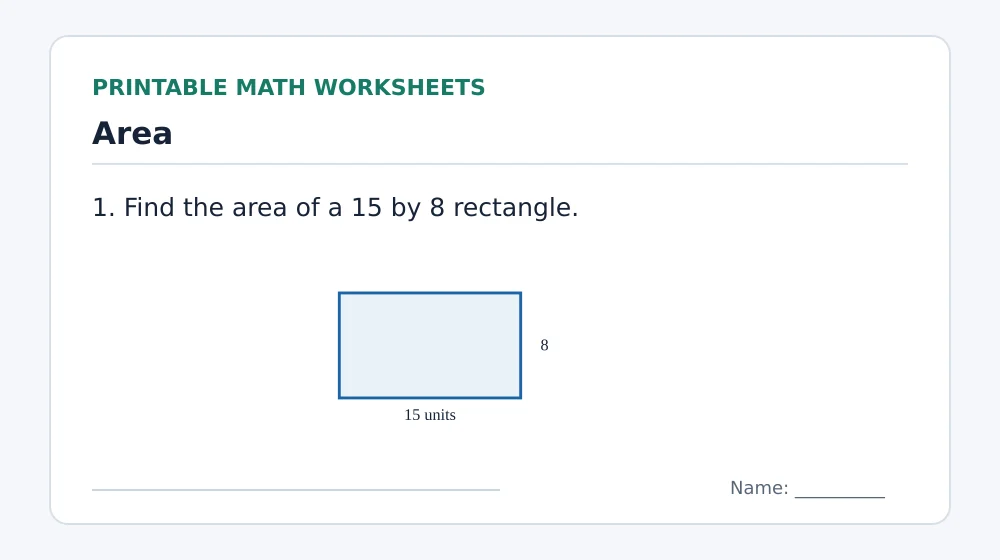
Question: Find the area of a 15 by 8 rectangle.
Answer: 120
- Area = length × width = 120 square units
This example is generated from a fixed seed so the explanation and answer refer to the exact same mathematical problem.
Teaching notes
The generator offers Easy, Standard and Challenge numerical ranges. These are practice settings, not school curriculum levels or official assessment standards.
- Choose the formula for the specific visible shape; area of a rectangle is length × width.
- Area measures a two-dimensional region and must be reported in square units.
Always review the printed answer key before distributing worksheets to a classroom.
Common mistakes
- Confusing slant length with perpendicular height.
- Using the wrong square or cubic units.
Check your answers
The answer-key PDF is generated from the same exact problem set and seed as the practice sheet. Use it after attempting each question. You can reproduce the sheet later using the same topic, difficulty, question count and seed.
For printing, select US Letter or A4.
Compare related practice skills
These generators teach different tasks. Choose the exercise that matches the specific skill you need.