Equivalent Fractions Worksheets
Find a missing numerator or denominator in equivalent fractions using the same scale factor on top and bottom.
Equivalent Fractions Worksheets
Practice worksheet · Sheet ID 20261104
Quick answer check · Your answers stay in this browser. Enter the answer format shown beside each question, then check without revealing the answer key.
Enter your answers to begin.
Equivalent fractions versus fraction addition
Equivalent fractions name the same quantity using different numerators and denominators; unlike-denominator addition combines two quantities.
Check an example: Example: 1/2 = 3/6 is an equivalence. But 1/2 + 1/3 = 5/6 is an addition problem.
Questions to answer before printing
Use equivalent-fraction practice when learners must recognize or produce different numerator–denominator pairs for the same value.
What makes two fractions equivalent?
Multiply or divide the numerator and denominator by the same nonzero number. For example, 2/3 = 6/9 because both terms of 2/3 were multiplied by 3.
How is this different from adding fractions?
Equivalence renames one quantity; addition combines quantities. A request such as 1/2 + 1/3 belongs in a different practice generator even though the calculation uses equivalent fractions.
Standards context: Common Core: Grade 5 Fractions. Describes equivalent forms as a strategy for fraction operations.
Prepared by Math Worksheet Studio · Content updated November 8, 2026. Mathematics and printer output require classroom review.
Equivalent fractions worksheet: printable practice options
Create a fresh practice sheet for this specific math skill using the generator above. These are automatically generated questions, not scans of a fixed worksheet or promises of alignment to a particular school grade.
What is included?
- Easy, Standard or Challenge number ranges and up to 40 questions in Standard mode (some topic settings have lower limits).
- Missing part: Mixed, Numerator, Denominator.
- Separate student questions and matching teacher answer keys on A4 or US Letter, both reproducible with the same seed.
- Step-by-step solutions are also available for this verified topic.
How to use this worksheet
- Read both numerators and denominators carefully.
- Find a common denominator or simplify only when the operation requires it.
- Compare your reduced fraction to the answer key.
Refresh the seed to generate another distinct set. For review, download the separate answer PDF instead of printing answers over the questions. Worked steps are available only on step-verified topics.
Example printable practice
A fixed-seed preview created from the same deterministic generator used above.
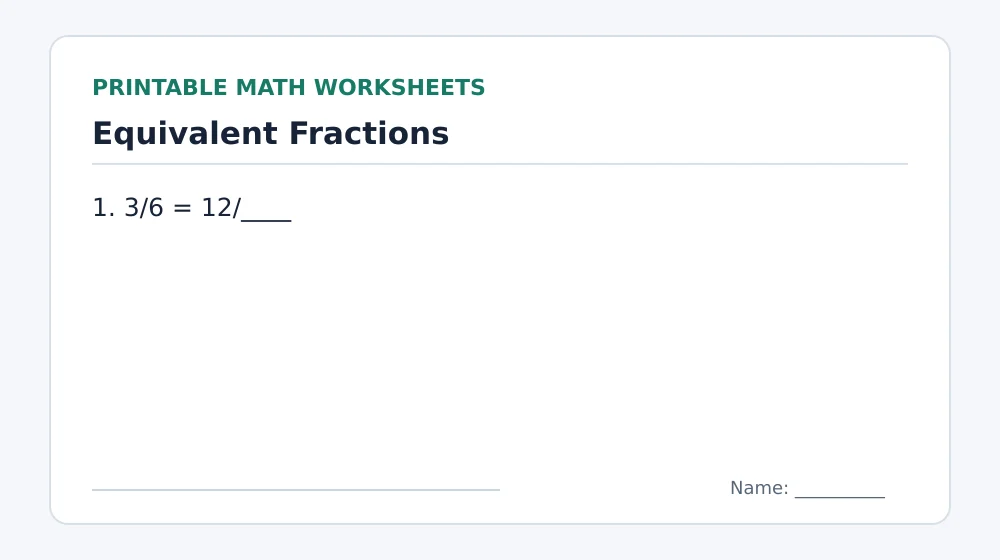
Worked example
Question: 3/6 = 12/____
Answer: 24
- Multiply numerator and denominator by 4
- 6 × 4 = 24
This example is generated from a fixed seed so the explanation and answer refer to the exact same mathematical problem.
Teaching notes
The generator offers Easy, Standard and Challenge numerical ranges. These are practice settings, not school curriculum levels or official assessment standards.
- Multiply or divide the numerator and denominator by the same nonzero integer to preserve value.
- Compare fractions using exact cross products or a common denominator rather than matching only one part.
Always review the printed answer key before distributing worksheets to a classroom.
Common mistakes
- Adding denominators when adding fractions.
- Forgetting to simplify the resulting numerator and denominator.
Check your answers
The answer-key PDF is generated from the same exact problem set and seed as the practice sheet. Use it after attempting each question. You can reproduce the sheet later using the same topic, difficulty, question count and seed.
For printing, select US Letter or A4.
Compare related practice skills
These generators teach different tasks. Choose the exercise that matches the specific skill you need.