Mean Absolute Deviation Worksheets
Measure variability from 5, 6 or 8 observations, including balanced and right-skewed samples. Mean and mean absolute deviation are calculated as exact simplified fractions.
Mean Absolute Deviation Worksheets
Practice worksheet · Sheet ID 20261104
Quick answer check · Your answers stay in this browser. Enter the answer format shown beside each question, then check without revealing the answer key.
Enter your answers to begin.
Mean deviation worksheet: printable practice options
Create a fresh practice sheet for this specific math skill using the generator above. These are automatically generated questions, not scans of a fixed worksheet or promises of alignment to a particular school grade.
What is included?
- Easy, Standard or Challenge number ranges and up to 40 questions in Standard mode (some topic settings have lower limits).
- Data pattern: Symmetric, Skewed.
- Sample size: Mixed (5, 6 or 8), 5 observations, 6 observations, 8 observations.
- Separate student questions and matching teacher answer keys on A4 or US Letter, both reproducible with the same seed.
- Step-by-step solutions are also available for this verified topic.
How to use this worksheet
- Add every observation and divide by the sample size to find the exact mean.
- For each observation subtract the mean and take the absolute value; keep any fractional results exact.
- Add all the absolute deviations and divide by the total number of observations. Do not round until after checking the exact fraction.
Refresh the seed to generate another distinct set. For review, download the separate answer PDF instead of printing answers over the questions. Worked steps are available only on step-verified topics.
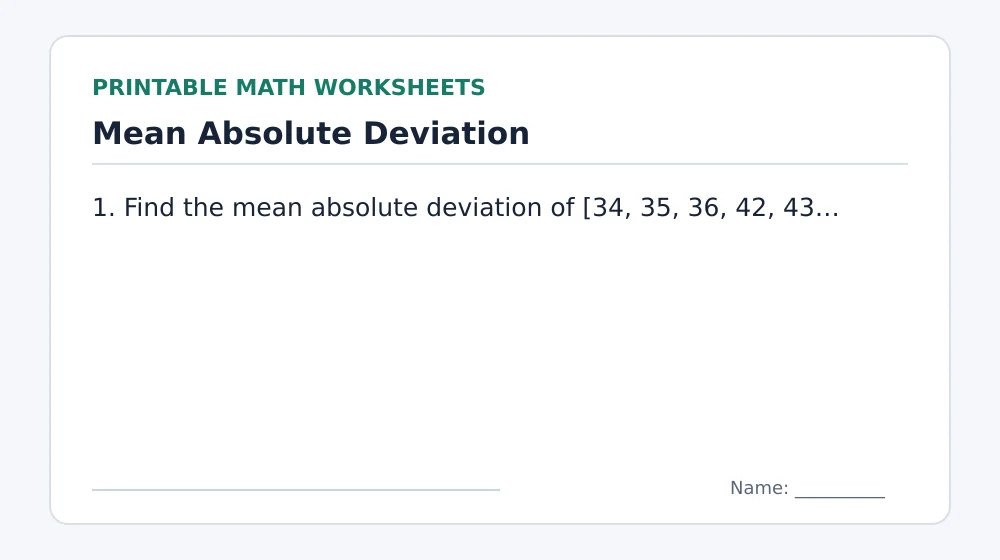
Example printable practice
A fixed-seed preview created from the same deterministic generator used above.
Worked example
Question: Find the mean absolute deviation of [34, 35, 36, 42, 43, 44].
Answer: 4
- There are 6 observations; mean = 234/6 = 39.
- Absolute deviations (first group): 5, 4, 3.
- Absolute deviations (remaining): 3, 4, 5.
- Sum the absolute deviations and divide by 6: 144/36 = 4.
This example is generated from a fixed seed so the explanation and answer refer to the exact same mathematical problem.
Teaching notes
The generator offers Easy, Standard and Challenge numerical ranges. These are practice settings, not school curriculum levels or official assessment standards.
- Compute the arithmetic mean from all observations before calculating absolute differences.
- Average the absolute deviations, not the signed deviations, which can cancel.
Always review the printed answer key before distributing worksheets to a classroom.
Common mistakes
- Dividing the total absolute deviation by the number of distinct values instead of the full sample size.
- Rounding a fractional mean early, which changes every absolute deviation.
Check your answers
The answer-key PDF is generated from the same exact problem set and seed as the practice sheet. Use it after attempting each question. You can reproduce the sheet later using the same topic, difficulty, question count and seed.
For printing, select US Letter or A4.
Compare related practice skills
These generators teach different tasks. Choose the exercise that matches the specific skill you need.