Long Division Worksheets
Practice long division with one- or two-digit divisors and three- or four-digit dividends. Choose exact quotients or remainders, with matching worked steps and printable brackets.
Long Division Worksheets
Practice worksheet · Sheet ID 20261104
Quick answer check · Your answers stay in this browser. Enter the answer format shown beside each question, then check without revealing the answer key.
Enter your answers to begin.
Long division records work; division facts test recall
Long division is an algorithm with quotient positions, multiplication, subtraction and possible remainders. Division fact sheets focus on numerical fluency.
Check an example: Example: 125 ÷ 6 = 20 remainder 5; show the intermediate quotient steps instead of writing only 20 R5.
Questions to answer before printing
Use long-division worksheets when students need room to show the quotient algorithm; division-fact drills test quick recall and are a different task.
How can I check a long-division answer with a remainder?
For 125 ÷ 6, the result is 20 remainder 5. Check 6 × 20 + 5 = 125. The remainder 5 is nonnegative and smaller than divisor 6.
What should the student write on the page?
Record the quotient place values and the divide–multiply–subtract–bring-down steps, not just the final answer. The generator produces reproducible questions and a separate matching answer key.
Standards context: Common Core: Grade 6 Number System. Includes multi-digit division using the standard algorithm.
Prepared by Math Worksheet Studio · Content updated November 8, 2026. Mathematics and printer output require classroom review.
Long division practice worksheets: printable practice options
Create a fresh practice sheet for this specific math skill using the generator above. These are automatically generated questions, not scans of a fixed worksheet or promises of alignment to a particular school grade.
What is included?
- Easy, Standard or Challenge number ranges and up to 40 questions in Standard mode (some topic settings have lower limits).
- Remainder practice: Mixed, Yes, No.
- Divisor size: Mixed, One, Two.
- Dividend size: Mixed, Three, Four.
- Separate student questions and matching teacher answer keys on A4 or US Letter, both reproducible with the same seed.
- Step-by-step solutions are also available for this verified topic.
How to use this worksheet
- Begin with the first dividend digits large enough to divide by the divisor; two-digit divisors may need more leading digits.
- Divide, multiply, subtract and bring down each following digit; write a zero in the quotient when a later partial dividend is too small.
- Verify dividend = divisor × quotient + remainder. The remainder must be nonnegative and strictly less than the divisor.
Refresh the seed to generate another distinct set. For review, download the separate answer PDF instead of printing answers over the questions. Worked steps are available only on step-verified topics.
Example printable practice
A fixed-seed preview created from the same deterministic generator used above.
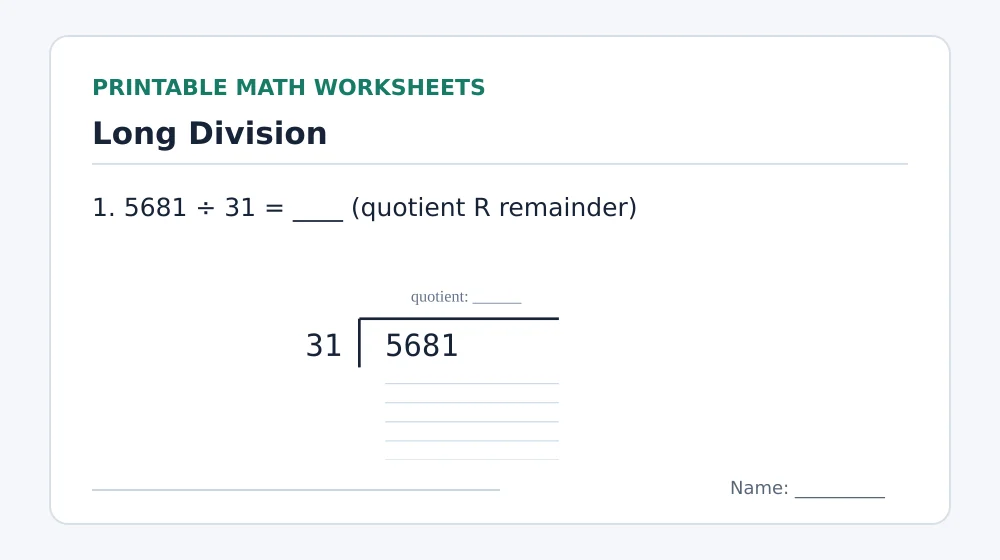
Worked example
Question: 5681 ÷ 31 = ____ (quotient R remainder)
Answer: 183 R 8
- Bring down 5: 5 is below 31; use the next dividend digit.
- Step 2, bring down 6: 56 ÷ 31 gives quotient digit 1; subtract 31; carry 25.
- Step 3, bring down 8: 258 ÷ 31 gives quotient digit 8; subtract 248; carry 10.
- Step 4, bring down 1: 101 ÷ 31 gives quotient digit 3; subtract 93; carry 8.
- Check: 31 × 183 + 8 = 5681
This example is generated from a fixed seed so the explanation and answer refer to the exact same mathematical problem.
Teaching notes
The generator offers Easy, Standard and Challenge numerical ranges. These are practice settings, not school curriculum levels or official assessment standards.
- Divide, multiply, subtract, and bring down one place-value digit at a time.
- The remainder must be nonnegative and smaller than the positive divisor; multiply back to verify.
Always review the printed answer key before distributing worksheets to a classroom.
Common mistakes
- Skipping a zero digit in the middle of the quotient.
- Choosing a partial quotient digit larger than 9 or leaving a remainder at least as large as the divisor.
Check your answers
The answer-key PDF is generated from the same exact problem set and seed as the practice sheet. Use it after attempting each question. You can reproduce the sheet later using the same topic, difficulty, question count and seed.
For printing, select US Letter or A4.
Compare related practice skills
These generators teach different tasks. Choose the exercise that matches the specific skill you need.