Surface Area Worksheets
Practice finding the surface area of supported cubes and rectangular prisms. Work with visible dimensions and square units rather than confusing surface area with volume.
Same seed, questions and vector diagrams as the downloaded student edition.
Surface Area Worksheets
Practice worksheet · Sheet ID 20261104
Quick answer check · Your answers stay in this browser. Enter the answer format shown beside each question, then check without revealing the answer key.
Enter your answers to begin.
Surface area measures exposed faces, not interior volume
Surface area adds 2-D faces and is measured in square units. Volume measures three-dimensional capacity in cubic units.
Check an example: For a 2 cm × 3 cm × 4 cm prism, surface area = 52 cm² but volume = 24 cm³.
Questions to answer before printing
Use surface-area practice when the question asks for exposed two-dimensional faces of a solid or a joined solid, measured in square units.
How is the surface area of a rectangular prism calculated?
For a closed rectangular prism, SA = 2(lw + lh + wh). With sides 2 cm, 3 cm and 4 cm, SA = 2(6 + 8 + 12) = 52 cm².
What changes when two solids are joined?
A shared internal face is no longer exposed. Add the individual outer surface areas and subtract the shared contact area twice, once for each hidden face. Use the dedicated composite-solid mode for supported joined prisms.
Standards context: Common Core: Grade 6 Geometry. Discusses solid nets and surface-area calculations.
Prepared by Math Worksheet Studio · Content updated November 8, 2026. Mathematics and printer output require classroom review.
Surface area worksheet: printable practice options
Create a fresh practice sheet for this specific math skill using the generator above. These are automatically generated questions, not scans of a fixed worksheet or promises of alignment to a particular school grade.
What is included?
- Easy, Standard or Challenge number ranges and up to 40 questions in Standard mode (some topic settings have lower limits).
- Solid type: Rectangular prism, Cube.
- Separate student questions and matching teacher answer keys on A4 or US Letter, both reproducible with the same seed.
- Step-by-step solutions are also available for this verified topic.
How to use this worksheet
- Read the dimensions shown in the question.
- Choose the appropriate area, volume or surface-area formula.
- Record square or cubic units where appropriate.
Refresh the seed to generate another distinct set. For review, download the separate answer PDF instead of printing answers over the questions. Worked steps are available only on step-verified topics.
Example printable practice
A fixed-seed preview created from the same deterministic generator used above.
Cylinder surface area worksheets — circular bases, curved surface, and volume
A closed right circular cylinder has two circular ends and one curved lateral surface. With radius r and vertical height h, the curved part unwraps to a rectangle of width 2πr and height h. The total surface area is 2πr² + 2πrh; the lateral area alone is 2πrh, and the volume is πr²h.
- For a radius of 3 cm and height of 5 cm, the circular bases total 18π cm², while the lateral rectangle contributes 30π cm².
- The complete closed surface area is therefore 48π cm². If only the curved side is requested, do not include the bases.
- Volume uses cubic units: π × 3² × 5 = 45π cm³. Square units for surface area and cubic units for volume are not interchangeable.
Use the separate Cylinder panel above for reproducible student problems, matching answer keys, and worked solutions in Letter or A4 format. The diagrams are dimension-proportional unfolded nets with two circular disks and one exact circumference-by-height rectangle, rather than inaccurate perspective pictures. The original cube and rectangular-prism worksheets still work separately.
Surface area of triangular prisms and pyramids — exact unfolded faces
Closed right triangular prism: Add both triangular bases and all three rectangular sides. For a right-triangle base with legs a, b, hypotenuse c and prism length L, the total surface is ab + (a + b + c)L. The printer-friendly net has these actual side widths, not arbitrary decorative proportions.
Right square pyramid: One square base plus four isosceles triangular side faces give s² + 2sl, where l is the slant height along a triangular face. Do not replace l with the perpendicular distance from the apex to the base plane.
Regular triangular pyramid (tetrahedron): This is a special triangular pyramid with four congruent equilateral faces. Each equilateral face has area √3s²/4, so its total surface is s²√3. A pyramid with unequal triangular faces does not have this shortcut formula.
- For a right triangular prism with base 3–4–5 cm and length 7 cm, surface area = 3 × 4 + (3 + 4 + 5) × 7 = 96 cm².
- For a right square pyramid with base edge 8 cm and face slant height 7 cm, surface area = 64 + 2 × 8 × 7 = 176 cm².
- For a regular tetrahedron whose edge is 6 cm, the four equilateral faces have combined exact area 36√3 cm².
The dedicated surface-area panel offers a mixed set or separate solid modes. Its vector nets show two triangles plus three rectangles, one square plus four triangles, or four identical equilateral triangles. They include matching student, answer and worked-step editions. General triangular pyramids, oblique prisms, and compound three-dimensional solids are not claimed as supported.
Surface area of prisms and cylinders — all closed faces in one practice set
For total surface area, include both bases and every lateral side. A rectangular prism has six rectangular faces; a right triangular prism has two triangular ends and three lateral rectangles; a closed right circular cylinder has two circular disks and one curved side.
- Rectangular prism 2 cm × 3 cm × 5 cm: SA = 2(6 + 10 + 15) = 62 cm².
- Right triangular prism with legs 3 cm and 4 cm, hypotenuse 5 cm and length 5 cm: SA = 3 × 4 + (3 + 4 + 5) × 5 = 72 cm².
- Closed cylinder with radius 2 cm and height 5 cm: SA = 2π × 2² + 2π × 2 × 5 = 28π cm².
A real rectangular-prism net displays six faces, the triangular prism net has two right-triangle bases plus three rectangles, and the cylinder net has two circular disks plus a circumference-by-height rectangle. The mixed worksheet interleaves them without replacing the original cube, cylinder or pyramid tools. Open or hollow cylinders are not part of this total-surface mode.
Surface area from nets — count every exposed face, not just the outline
An unfolded solid net allows you to calculate the total surface area by summing each real two-dimensional face. The net area does not change when the solid folds. The new print-ready exercises include a rectangular prism with six rectangles, a right triangular prism with two triangles and three rectangles, a closed cylinder with two circles and a circumference-by-height rectangle, a right square pyramid with four triangular faces and a square base, and a regular tetrahedron with four congruent equilateral faces.
- For a closed rectangular prism 2 cm × 3 cm × 5 cm, the net area is 2(2×3 + 2×5 + 3×5) = 62 cm².
- For a closed cylinder of radius 2 cm and height 5 cm, the net area is 2π×2² + 2π×2×5 = 28π cm². The curved lateral wall becomes a rectangle whose width is the true circumference.
- For a right square pyramid, each triangular face uses the face slant height, not the vertical apex-to-base height. For a regular tetrahedron, all four triangular faces are equilateral; its exact total area is s²√3.
Surface area of composite solids — remove both concealed faces
Joining two closed rectangular prisms creates a composite solid. The shared contact rectangle is counted once on each separate box, but neither side of this internal contact is part of the exposed exterior surface. Therefore use SA(composite) = SA(box A) + SA(box B) − 2×area(shared joint).
For example, a bottom prism of 8 × 3 × 2 cm with a 4 × 3 × 2 cm top prism joined at one end has separate surface areas 92 cm² and 52 cm². The common contact face is 4 × 3 = 12 cm², so the exposed total is 92 + 52 − 2×12 = 120 cm². The true unfolded composite net comprises two congruent L-shaped end faces and six rectangles whose widths match the actual boundary lengths.
Use the dedicated panels for student questions, independent answer keys and fully worked steps. The composite generator is specifically limited to two full-depth, orthogonally joined rectangular prisms; it is not a general arbitrary-solid calculator. Source keyword volumes and difficulty scores are historical research snapshots, not live traffic or rankings. Review the generated student sheet and separate answer key for your classroom needs.
Worked example
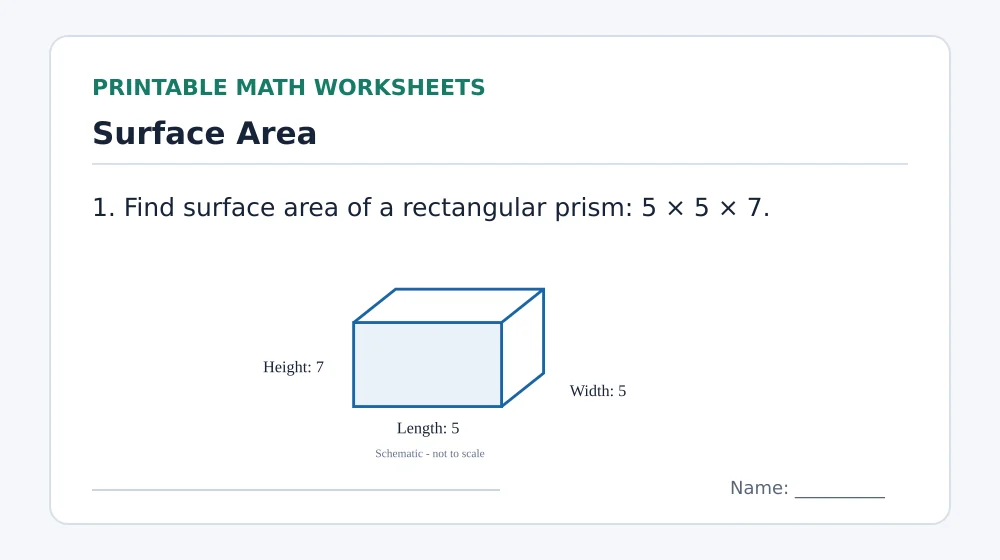
Question: Find surface area of a rectangular prism: 5 × 5 × 7.
Answer: 190
- SA = 2(lw + lh + wh)
- Surface area = 190 square units
This example is generated from a fixed seed so the explanation and answer refer to the exact same mathematical problem.
Teaching notes
The generator offers Easy, Standard and Challenge numerical ranges. These are practice settings, not school curriculum levels or official assessment standards.
- Count every exposed face exactly once and omit joined internal faces when finding composite surface area.
- Net areas must use square units; do not substitute volume or a slant height where perpendicular height is required.
Always review the printed answer key before distributing worksheets to a classroom.
Common mistakes
- Computing volume instead of total area of faces.
- Using cubic rather than square units.
Check your answers
The answer-key PDF is generated from the same exact problem set and seed as the practice sheet. Use it after attempting each question. You can reproduce the sheet later using the same topic, difficulty, question count and seed.
For printing, select US Letter or A4.
Compare related practice skills
These generators teach different tasks. Choose the exercise that matches the specific skill you need.